AI Agents Found a Zero-Day in 11 Minutes. What That Means for Your Website
What happened
On 20 November 2026, Amazon Threat Intelligence disclosed something security teams had warned about for years, and it is now real. A threat actor used autonomous AI agents to find a flaw nobody had reported before, and to exploit it, with almost no human help.
The actor used an open source framework called Cairn, which runs AI agents that test systems on their own. The operator gave the agents a list of IP addresses and a short goal: obtain shell access. The agents chose their own methods from there.
Over about 48 hours from 8 September 2026, the agents probed servers belonging to universities in East Asia. Against one server they found MONAI Label, an open source tool for AI assisted medical image annotation, built by Project MONAI. The agents mapped its API, found a file upload endpoint with a filename parameter, tested it for path traversal, and found it was vulnerable.
Amazon says about 11 minutes passed between the agents mapping the API and writing arbitrary files to the server. The agents then wrote a Python reverse shell into sitecustomize.py, a file Python loads automatically when a new process starts. They called a training API endpoint, which started a new Python process, loaded the payload, and opened a reverse shell running as root. The actor later gave the agents a proxy that tunnelled into a second university network, and the server behind it ran the same vulnerable software.
Amazon could reconstruct all of this because the operator had left its own Cairn control panel exposed to the internet with no password. The prompts and the agents’ output were visible.
Watch the Video
https://www.youtube.com/watch?v=epEH_BURQio
The flaw, in plain English
The flaw is tracked as CVE-2026-133968. It is a path traversal bug in MONAI Label’s datastore upload endpoints. A caller can write a file anywhere the server process can write, and that leads to remote code execution. It is rated 9.8 out of 10.
Every release up to and including 0.8.5 is affected. The fix is MONAI Label 0.8.6, released 21 November 2026, and then 0.8.7, released 24 November 2026, which fixes further flaws. If you run MONAI Label, update to 0.8.7 or later.
Two details make this flaw worse. First, MONAI Label ships with authentication turned off by default, so anyone who can reach the server can use it, with no login needed. Second, the flaw was exploited in the wild starting in September 2026. CISA added it to its Known Exploited Vulnerabilities catalog on 23 November 2026.
Amazon attributes the campaign to a China linked actor with moderate confidence, based on Simplified Chinese prompts, China Standard Time settings, and target selection. It assesses with high confidence that the flaw was a zero day when it was exploited.
Why this matters if you do not run MONAI Label
Most readers of this blog will never run MONAI Label. It is a research tool for medical imaging. So why should a small business owner, or anyone with a WordPress website, care?
Because the method is the story, not the product. Three things changed.
First, speed. Finding a new flaw used to take a skilled human hours or days. Here, agents went from mapping an API to writing files in about 11 minutes. Your patch window is now measured in minutes and hours, not weeks. A flaw disclosed on Monday can be found and used against unpatched systems before many teams have even read the advisory.
Second, scale. One operator gave the agents a target list and a goal. The agents did the probing, the testing, and the exploitation. One person can now run a campaign that used to need a team. That means more systems get probed, including small ones that attackers used to ignore.
Third, exposed tools are the way in. The agents did not break strong passwords or clever defences. They found a research server sitting on the internet, with authentication off, running an old version. That pattern is everywhere: admin panels, test sites, old plugins, file upload tools, and services left open because someone needed them once and forgot them.
WordPress owners have seen the same pattern this month. WordPress 7.1.5 fixed 19 flaws, including a critical one rated 9.1. Six WordPress plugins carried a hidden backdoor, and a fake plugin was found running attacker JavaScript on visitors. The tools change. The lesson does not: update fast, and do not leave things exposed.
Read our guide: WordPress 7.1.5 Is Out: A Security Update You Should Not Skip
What to do now: 6 steps
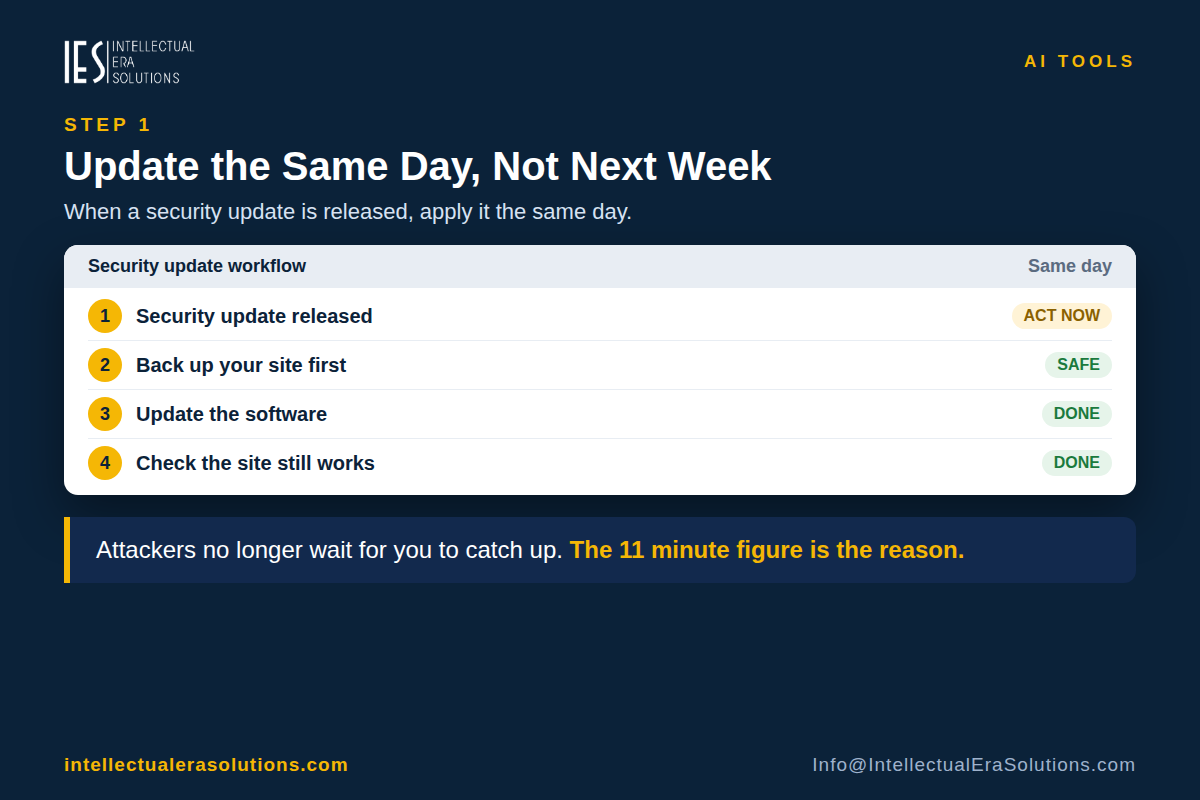
1. Update the same day, not next week
When WordPress, a plugin, a theme, or any software you run releases a security update, apply it the same day. Back up first, then update, then check the site still works. The 11 minute figure is the reason: attackers no longer wait for you to catch up.
If you use a maintenance plan, ask your provider how fast security updates go out. Same day should be the answer. Our website maintenance services cover this, and you can ask us about it on the contact page.
2. Turn authentication on, everywhere
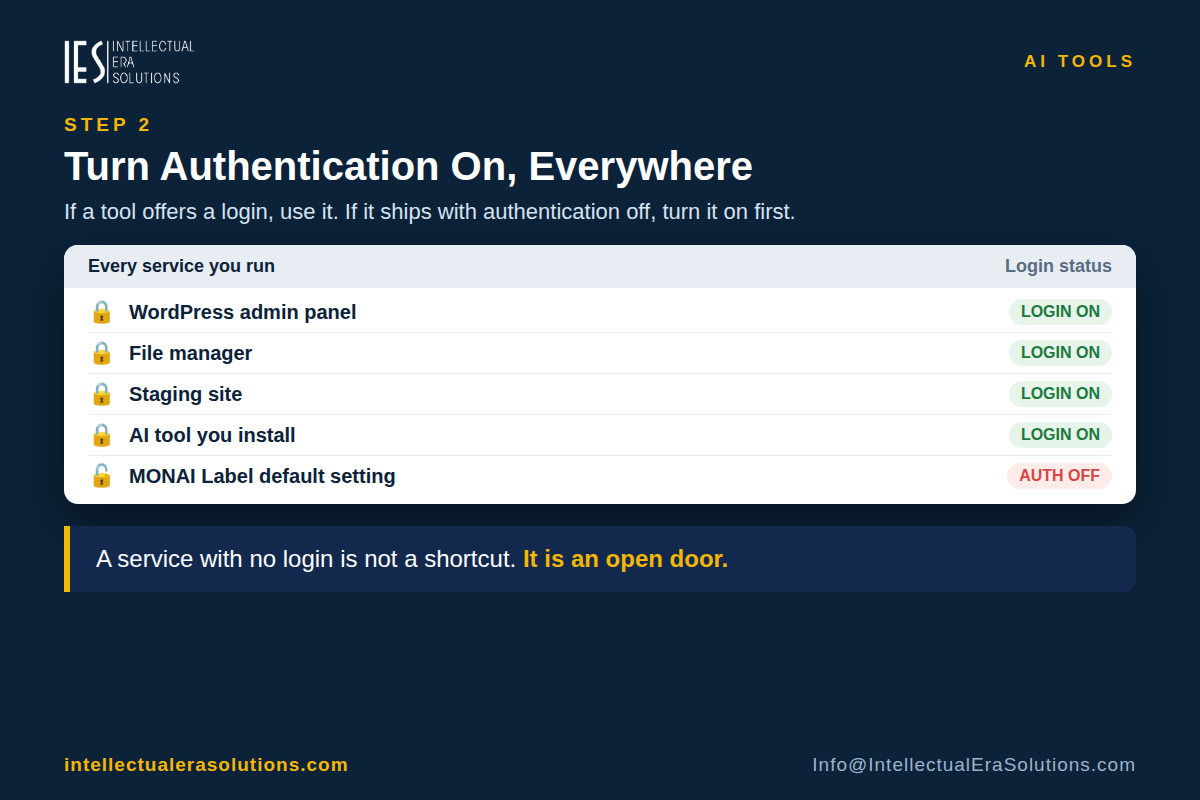
If a tool offers a login, use it. If it ships with authentication off, turn it on before you expose it to the internet. This applies to admin panels, file managers, staging sites, and any AI tool you install. A service with no login is not a shortcut. It is an open door.
Check your WordPress admin users too. Remove accounts you do not recognise, and give each real user only the role they need.
3. Do not expose what does not need to be public
Ask one question about every service you run: does the public internet need to reach this? If the answer is no, restrict it. Use IP allowlisting, a VPN, or your host’s access controls. Staging sites, test installs, and internal tools should not be public by accident.
The Cairn operator’s own control panel was exposed with no password. The attackers’ tool was the leak. Your own tools can leak the same way.
4. Remove what you do not use
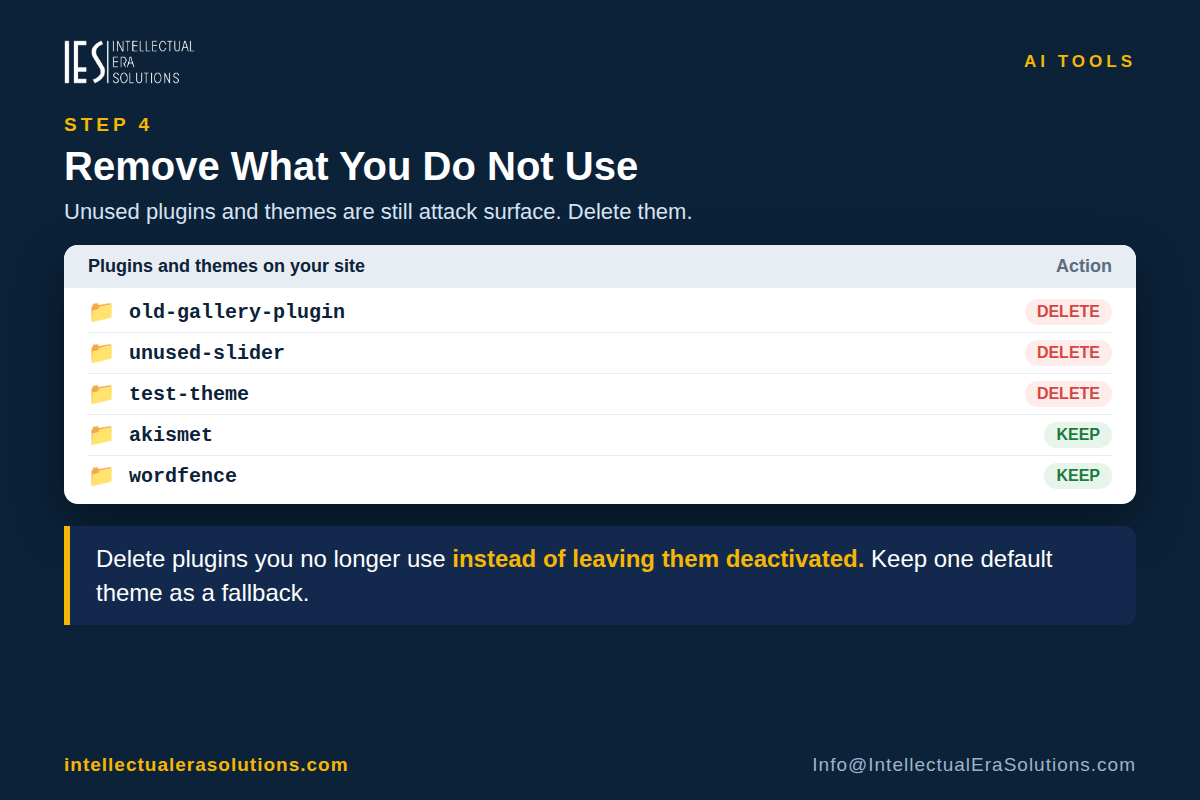
Unused plugins, themes, and software are still attack surface. Attackers probe for them, and AI agents probe faster. Delete plugins you no longer use instead of leaving them deactivated. Do the same for old themes, keeping one default theme as a fallback.
5. Keep backups you have actually tested
A backup you have never restored is a hope, not a plan. Keep a recent backup off the server, and test a restore at least once, so you know it works before you need it. After an incident, a clean restore is often faster than cleaning a hacked site by hand.
6. Watch for the signs, and act fast
If your site redirects visitors, shows strange ads, sends spam, or your host warns you, treat it as urgent. Our guide How to Tell If Your WordPress Site Is Hacked (7 Warning Signs) goes live on 4 December and walks through the checks step by step.
What this does not mean
This is not a reason to stop using AI. AI agents are also used to defend systems, to find flaws before attackers do, and to patch faster. The same speed that helps attackers helps defenders who are ready.
It is also not a reason to panic about every AI headline. The practical change is simple: the time between a flaw being found and being used has shrunk. The defence is the same work, done faster: update, lock things down, remove what you do not need, and keep backups.
The bottom line
AI agents found a zero day in about 11 minutes and took root on a university server. Nobody had reported that flaw before the agents found it. The fix exists now, MONAI Label 0.8.7, and CISA lists the flaw as actively exploited.
For your own website, the takeaway is not about MONAI Label. It is that patching next week is no longer fast enough, and that anything exposed without a login will be found. Update the same day, turn authentication on, and close what does not need to be public.
If you want help with that, contact us or ask for a free website audit. We will check your WordPress version, plugins, and exposed services, and report back within 48 hours.
Sources
- Amazon Threat Intelligence, disclosed 20 November 2026: autonomous AI agents using the Cairn framework found and exploited a zero day in MONAI Label, about 11 minutes from API mapping to arbitrary file writes, root reverse shell on a university server.
- CVE-2026-133968, CVSS 9.8, path traversal in MONAI Label datastore upload endpoints, affects 0.8.5 and earlier, exploited in the wild starting September 2026.
- MONAI Label 0.8.6 released 21 November 2026, 0.8.7 released 24 November 2026. Update to 0.8.7 or later.
- CISA Known Exploited Vulnerabilities catalog, added 23 November 2026.